Your best manager has 11 direct reports. You have two obvious moves, and both of them break something.
Widen the span and accept that she is stretched. Or promote someone under her, hand them four of the reports, and add a management layer to the chart. The second option feels like the responsible one. It is also the one you cannot easily undo.
Here is the default I would defend: widen first, and treat a new layer as the last move rather than the first. The rest of this post is why, what genuinely earns a layer anyway, and how to check your answer before you tell anyone.
If you have not read the healthy span of control thresholds, start there. This post is the sequel to that one.
The three limits pull against each other
That span post shipped three numbers, which are the same constants our org health engine uses to score any chart:
- A span above 8 gets flagged, above 12 severe.
- A manager ratio above 40% of headcount gets flagged.
- A chart deeper than 6 levels gets flagged.
Read them together and you find the thing nobody mentions: you cannot satisfy all three by adding managers. They trade against each other.
Your manager at 11 reports is over the span limit. Promote an intermediary and the span problem disappears: she now has 8, and the new lead has 4. Two numbers moved while you were not looking. Your manager count went up, pushing the ratio toward 40%. Your chart got one level deeper, spending part of your budget of 6.
Do that three or four times as you grow, solving each wide span locally, and you arrive somewhere familiar: every individual span looks healthy, and the company feels slow. That is the shape those three thresholds exist to catch. Fixing spans one at a time is exactly how organizations become tall without anyone deciding to make them tall.
So the real question is which of your three budgets you can afford to spend, rather than whether 11 is too many.
Why widening is the cheaper move
Widening a span costs attention. The manager has less time per person, 1:1s get shorter or less frequent, and some coaching stops happening.
That is a real cost. It is also reversible, immediate, and free. If it stops working in two months, you change it back and nobody's title moves.
A layer costs differently. It costs a salary, or a promotion you cannot rescind without damage. It costs a permanent hop between the strategy and the people doing the work, because every level is one more retelling. And it costs you optionality: the manager-of-four you created is now a manager, and if that team shrinks back to two people, you have a thin layer that is very awkward to remove. Our engine flags exactly this, a manager with a single report, and the reason it flags it is that these fossilize. The team shrank; the title did not.
Widening buys you time cheaply. A layer spends structure permanently. When you are uncertain, prefer the move you can undo.
The honest limit on this argument: widening has a ceiling, and past it the saving disappears and you are just quietly asking one person to do a job that does not fit in a week.
What actually earns a management layer
Here is where widening stops being the answer. Any one of these is a real signal:
The manager's own work has stopped happening. Not "is busy." Stopped. If the person's individual contribution has quietly become zero because their calendar is entirely 1:1s and escalations, you have already added a layer, you just have not staffed it or admitted it.
The reports need coaching, not direction. A span of 10 works when people mostly need context and unblocking. It fails when five of them are junior and need actual development, because development does not compress. This is the single most reliable signal in my experience, and it is about the composition of the team rather than its size.
There is a real internal candidate who wants it. A layer added around a specific person who is ready is a very different bet from a layer added around a vacancy you now have to fill. The second one takes months and often lands on someone who did not want to manage.
The span is above 12. Our engine calls this severe rather than flagged, and that distinction is deliberate. Past 12, widening stops being a trade-off you are making thoughtfully and becomes a queue.
Notice what is missing from that list: "we are growing" and "it seems more professional." Neither is a reason.
What the layer costs, in your own numbers
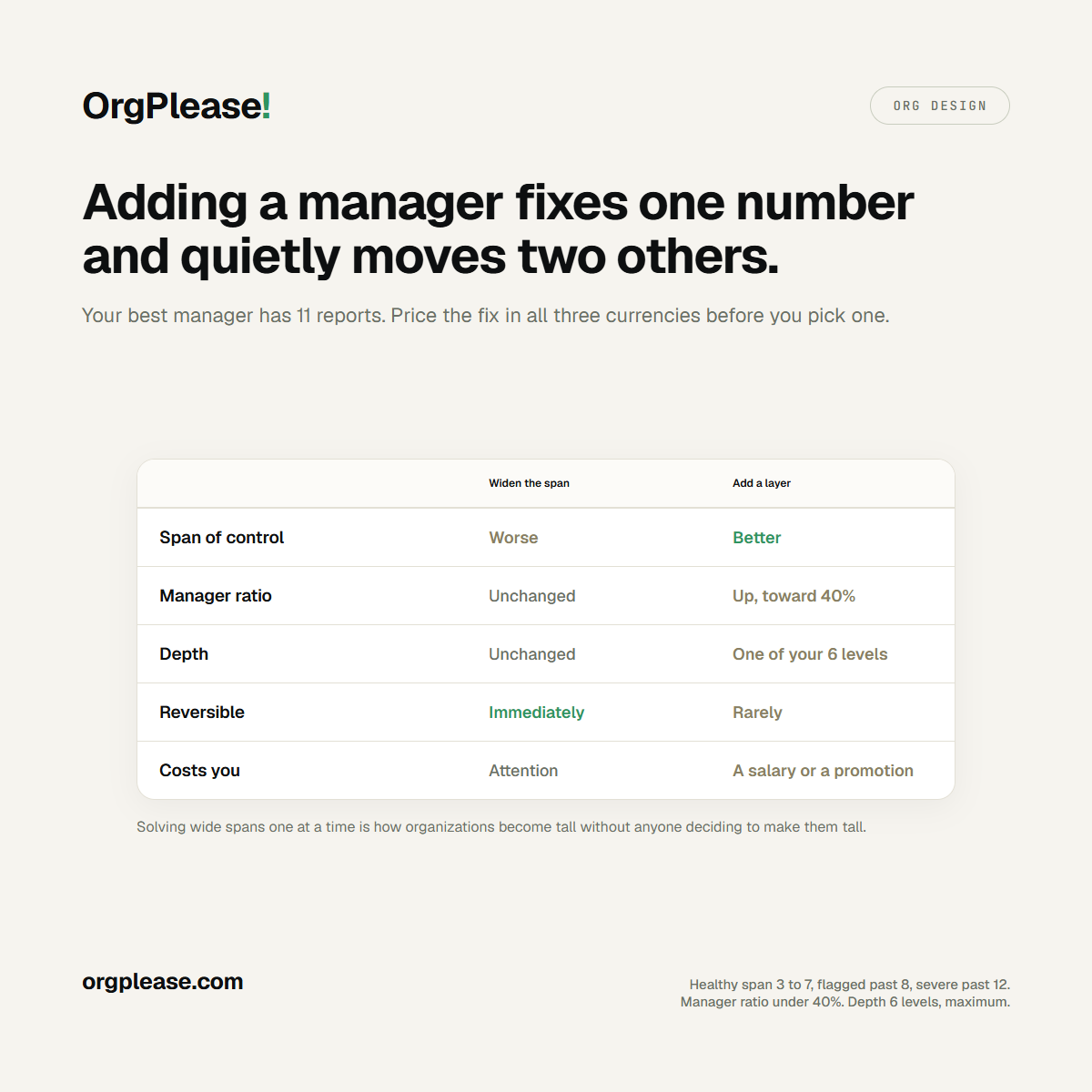
Before you commit, price it in the same three currencies:
| Widen the span | Add a layer | |
|---|---|---|
| Span | Worse (toward 8, then past it) | Better, at both levels |
| Manager ratio | Unchanged | Up, toward the 40% flag |
| Depth | Unchanged | One level deeper, out of 6 |
| Reversible | Yes, immediately | Rarely, without a demotion |
| Cost | Attention | A salary or a promotion |
A 60-person company with 4 levels and a 30% manager ratio has room. A 60-person company already at 5 levels and 38% does not, and needs to solve that manager's load some other way: moving two reports sideways to a peer, cutting the team's scope, or hiring an individual contributor who absorbs the work that is generating the escalations.
That last option gets skipped a lot. Sometimes a wide span is a symptom of understaffing one level down, and the fix is another doer rather than another manager.
Test it before you tell anyone
Whatever you pick, the cheap thing to do is check the numbers before the conversation rather than after.
Run the audit from the span post: =COUNTIF(C:C, B2) down your roster to count spans, remove duplicates on the manager column for your manager count, follow the longest chain for depth. Then write down what each option does to all three. Two minutes of arithmetic has talked me out of a reorg more than once.
If you would rather see it than compute it, OrgPlease! has scenario planning on every paid plan: model both versions on a private copy of your chart, compare them side by side, and promote one to live only if the numbers hold. Nobody sees the draft while you are deciding, which matters when the draft contains someone's promotion. (Our data model is re-upload based, so the chart reflects your last roster upload plus any edits you make in the app.)
The tool is optional. Doing the arithmetic before the announcement is not, and the reorg playbook covers what happens after you decide.
Bottom line
Widen first. Widening costs attention and gives it back the moment you reverse it. A layer costs a salary, a permanent hop, and a piece of your depth budget, and it is the move you will still be living with in two years.
Add the layer when the manager's own work has stopped, when the reports need real coaching, when someone ready actually wants the job, or when the span has passed 12. Add it deliberately, priced in all three numbers, rather than one wide span at a time.
See what each option does to your chart. Upload your roster, get a structural health report in about 60 seconds, and model the alternative before you commit. Free up to 25 people; scenario planning is on the paid plans. Start your free org chart
Related reading: Lire cet article en français · What's a healthy span of control? · How to plan a reorg without breaking the org you have · Org chart scenario planning